Emergency Commercial Roof Repair in Santa Rosa, CA
Commercial Roofing Services
An emergency call is about limiting water damage, not selling a new roof. The first priority is protecting people and contents, assessing the roof when access is safe, and identifying temporary water-control options before planning the permanent repair.
For an active leak, share the building location, where water is appearing, and any access or safety limits. The next step depends on site conditions and the condition of the roof. In Santa Rosa, CA the emergencies come from a few predictable places: an atmospheric river that overwhelms the drains, a windstorm that lifts a membrane, or ash and embers after a fire. Each one has a different first move.
Serving Santa Rosa • Rohnert Park • Petaluma • Windsor • Healdsburg • Sebastopol • Napa
Dry-in comes first
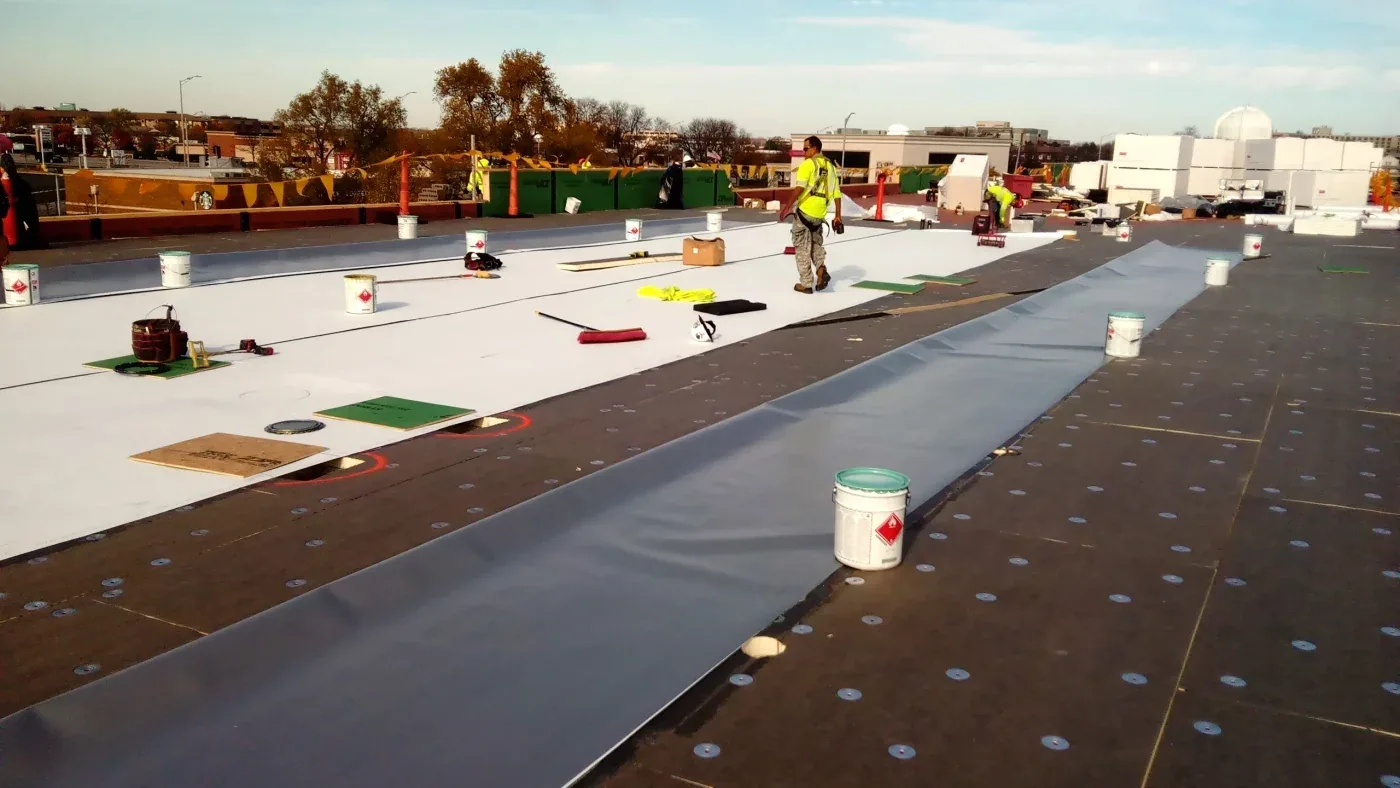
When we arrive, the order of work is simple. Make the area safe. Find the opening or the damaged zone. Stop water from entering the building. Then document everything with photos so the next steps, and any insurance claim, rest on facts.
Dry-in can mean several things depending on the roof. Sealing a failed flashing with a temporary compatible repair. Tarping an area where the membrane has been torn or lifted. Clearing blocked drains so standing water can leave. Securing loose edge metal or panels before the wind takes them.
We do not use the emergency to sell work you do not need. A temporary dry-in is exactly that: temporary. We tell you what it covers, what it does not, and what permanent repair should follow. Verdict: stop the water first, decide the rest once the building is dry.
What counts as an emergency
Call right away when water is entering an occupied or operating space, when a storm has torn or lifted membrane, when roof panels or edge metal are loose or hanging, when a roof has sagged or ponded heavily after rain, or when fire, impact or an equipment failure has opened the roof.
A slow stain on a tile after a week of drizzle is usually not a midnight call. It is still worth a visit, because tracing it early keeps it a small commercial roof leak repair. If you are not sure which category you are in, call anyway. We would rather talk you through it than have you wait on a problem that gets worse overnight.
Grocery stores, restaurants and medical offices have less room for delay. A wet ceiling over a food display or a treatment room is a business interruption on top of a roof problem, and those buildings go to the front of our thinking. A grocery store roof leaking over a food display is the plainest example.
Rain does not wait for business hours
Wind and fire are different calls
October 2017 showed both. Diablo winds gusted up to 70 mph during the fire siege, and the Tubbs Fire crossed Highway 101 into the city. Wind lifts membranes at the edges and corners first, then peels backward, which is why the first look on a wind damage roof repair call goes to the perimeter.
After a fire, the problems look different. Embers can burn into membranes and penetrations. Ash builds up in drains and gutters and clogs them just before the next rain. Heat can distort metal and warp insulation. Coffey Park, where the Tubbs Fire leveled an estimated 1,300 structures, mostly detached homes, shows the scale. For any commercial building within reach of embers and ash, a roof check and drain cleaning belong ahead of the next rain, and burn damage gets its permanent scope as fire damage roof repair once the building is dry.
Document it before the cleanup
Emergency repairs and insurance claims go together. Photos taken before and after the temporary work, a written description of what was found, and receipts for the dry-in all help a claim go smoothly. We document each step as we go.
If you carry coverage for the building, tell your carrier early, and keep damaged materials until they have been seen or photographed. Our roof insurance claim assistance pulls those records together so you are not rebuilding the story weeks later.
Here is what to do before we get there, if it is safe to do it:
- Move inventory, records and equipment away from the wet area.
- Place containers under drips and protect floors.
- Shut off power to affected circuits only if it is safe and you know how.
- Photograph the interior damage with a time stamp.
- Stay off the roof. A wet roof is a fall hazard.
Recommendation: after the dry-in, schedule the permanent repair promptly, because a tarp is not a roof.
Once the opening is controlled, make the next inspection part of the response. Photograph the temporary measure, note which roof zone remains exposed, and identify materials that need a permanent repair. Check the interior after the next rain and record whether water continued past the protected area. A prompt callback should not be confused with a promise that a crew can safely reach every roof during active weather. The repair plan starts when access is safe and the actual failure can be examined.
Commercial Roofing Questions
What should we do first when a commercial roof is leaking?
For an active leak, share where water is appearing and any access or safety limits. We can discuss assessment and temporary water-control options based on site conditions.
What does an emergency visit actually include?
We make the area safe, find where water is entering, apply a temporary stop such as a repair, tarp or drain clearing, and photograph the conditions. You leave with a clear description of what we did, what is still open, and what the permanent repair should be.
Will the temporary repair hold until you can fix it properly?
It is built to protect the building in the short term, not to replace the permanent work. A tarp or a temporary seal can handle some weather, but it can fail in wind or heavy rain. We tell you how long we expect it to buy you and push for a prompt follow-up.
Can you work with my insurance company?
We document the damage, the temporary measures and the recommended repair in writing with photos, and that record is what most carriers want to see. We do not decide coverage. That is between you and your insurer, but good documentation makes the process easier.
Is it worth calling at night for a small leak?
If it is in an occupied space, near electrical equipment, or getting worse, yes. A small drip that grows overnight can become a ceiling collapse or a wet-insulation problem by morning. If you are unsure, call and describe it. We will tell you whether it can wait for daylight.
Call now, we will get you dry
Tell us where water is appearing and what access or safety limits apply. We will discuss a practical first step for assessment and temporary water control.