Roofing for Manufacturers in Santa Rosa, CA
Industries We Serve
The costliest roof leak in a plant is the one that lands on a machine nobody can move. The membrane is a small line item next to a stopped line, yet most manufacturers buy a roof the way they buy paper towels. The roof deserves the same maintenance attention as any other piece of production equipment, and most of that attention costs very little.
Across Santa Rosa, CA and Sonoma County, makers work in plants, light industrial space and winery production halls. We walk your roofs the way a reliability engineer walks a line: find what is wearing, rank it by the damage a failure would do, and fix the cheap things before they turn into the expensive ones.
Serving Santa Rosa • Rohnert Park • Petaluma • Windsor • Healdsburg • Sebastopol • Napa
A plant roof is a process roof
Look at who makes things around here. Keysight Technologies keeps its headquarters in Fountaingrove and employs about 1,700 people in Santa Rosa. Amy's Kitchen runs a production facility in the city, and Petaluma adds Petaluma Poultry Processors, Lagunitas Brewing and Clover Sonoma dairy. A technology headquarters, a food plant, a dairy and a brewery each load a roof differently, through air handling, refrigeration condensers, fermentation exhaust or wash-down vapor.
That is why a generic reroof spec fails in a plant. The roof has to match what happens beneath it, and the right answer in a Petaluma food plant is not the right answer for an assembly hall. Our manufacturing plant roofing work starts with a walk of the process, not with a membrane brochure.
Exhaust, vibration and heat attack from inside
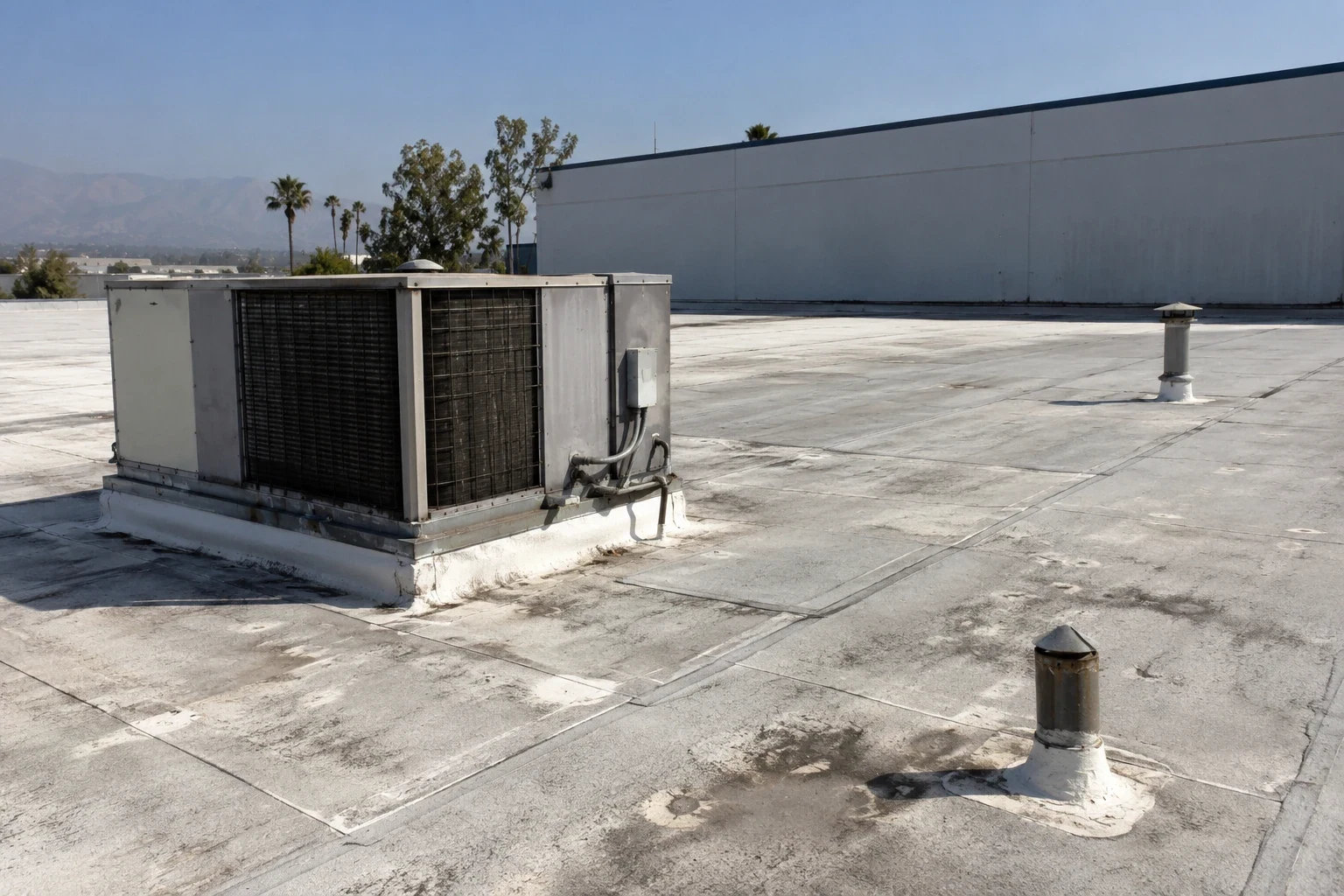
Plant roofs rarely fail from weather alone. Process exhaust can be acidic, greasy or hot, and it eats flashings and membrane near the stack. Vibrating equipment loosens fasteners and cracks sealant at the curb. Humid production areas push vapor up through the deck into the insulation, where it condenses and soaks the board while the top surface looks fine. Refrigerated rooms run the same problem in reverse, which is a daily concern for cold storage roofing.
The real problem is that nobody owns the roof. Maintenance owns the equipment, facilities owns the building, and the roof sits somewhere in between. Give it a name on the org chart, a calendar of visits and a log of every penetration, including the ones a contractor cut and forgot to mention. Every new unit should arrive with a proper curb and flashing detail, not a shrug.
Ash in the intake, shutoffs on the line
Time the roof to the shutdown
Tie roof work to the plant calendar. Annual maintenance outages, holiday shutdowns and slow seasons are the windows for anything noisy or intrusive. We stage materials ahead of time and open the roof in small areas that are dried in by the end of each shift, so production never sits under an open deck. Where a product cannot tolerate dust or odor, cold-applied adhesives and mechanical attachment replace torch and hot asphalt.
Restore before replacing when the roof allows it. A sound membrane over dry insulation can take a restoration coating that extends its life and cools the building, which eases the load on the cooling plant. Wet insulation is a replacement conversation, sectioned building by building so the plant never loses a whole facility at once. Verdict: survey in the quiet season, schedule the work for the next planned shutdown.
Food, dairy and wine halls play by different rules
With more than 350 wineries, Sonoma County holds a large stock of production halls, barrel rooms and tasting buildings. Wine and dairy both depend on steady interior temperatures and clean air, so a roof leak is also a spoilage event. Food plants add wash-down water and sanitation rules: nothing should shed, flake or drip into a product zone, and roof work needs debris control and access control before the first tool comes out.
Fire history matters in wine country. The 2017 Nuns Fire severely damaged Glen Ellen, and the 2020 Glass Fire destroyed 343 commercial buildings in Napa County. Edge details, vent screens and a clean roof surface matter for any production building at the edge of vineyards, because embers settle wherever debris gives them a place to sit.
Skip the tear-off nobody needs
Skip the full tear-off when a restoration will do. Skip premium membranes where stack exhaust will destroy them anyway, and skip patch after patch around a leaking unit when the curb needs rebuilding. Repainting a roof surface over wet insulation is not worth it, since the moisture underneath outlasts the paint. Spend instead on drains, curbs, exhaust shields and walk pads that keep foot traffic off the membrane.
If you lease your plant, bring the owner in early. Landlords and the property managers who run business parks often control the roof budget even when the tenant feels every drip, and that holds in a business park such as the Airport Business Center. And if the building also ships product, the dock side of the roof raises the same questions a logistics operator faces.
Commercial Roofing Questions
How do we keep dust and odor out of a production area during roof work?
Map the air first. We locate every intake and exhaust, choose cold-applied or mechanically attached systems near them, cover intakes during open-deck work and keep tear-off debris moving through enclosed chutes. Where product is exposed, ask your quality team for a list of tasks and hours that are off limits, and we will schedule around it.
Our process exhaust is corrosive. Which membrane survives it?
No membrane is immune, so deal with the exhaust as well. Systems such as KEE and PVC resist many fats, oils and vapors better than some alternatives, but the first move is to learn what is in the plume and, where possible, extend or redirect stacks so it does not land on the roof. Add protective flashing and a sacrificial walkway near the stack, then choose the system after we see what the exhaust has already done to the existing roof.
How can we find wet insulation without cutting the roof open?
An infrared scan on a clear evening shows warm, wet patches where the board is holding water, and a handful of small core cuts with moisture readings confirms the picture. Dry areas stay. Wet areas get replaced. That keeps the replacement to the footprint that needs it instead of the whole plant.
What does the new energy code mean for a plant reroof?
The 2025 California Building Standards Code and its Energy Code govern any permit application submitted from January 1, 2026 forward, and Santa Rosa adopted the 2025 California Building Code through Ordinance 2026-001. Insulation levels and reflectance requirements can reach a replacement, so bring your designer in before pricing. The county's reroofing guidelines also include a self-certification inspection policy, and your building division can tell you which path your scope falls under.
We have patched the same area for years. When is a patch no longer enough?
When the same spot needs patching twice, the patch is treating a symptom. Look for ponding nearby, wet insulation under it, or a failed curb within a few feet. Three patches in a season generally mean a section replacement costs less than a fourth patch, and it ends the call-out cycle.
Protect the line, not just the roof
Call Commercial Roofing Santa Rosa. We will walk your plant roofs and tell you plainly which need work now, which can wait for the next shutdown, and which need nothing.