Rooftop Equipment Curbs and Supports in Santa Rosa, CA
Commercial Roofing Services
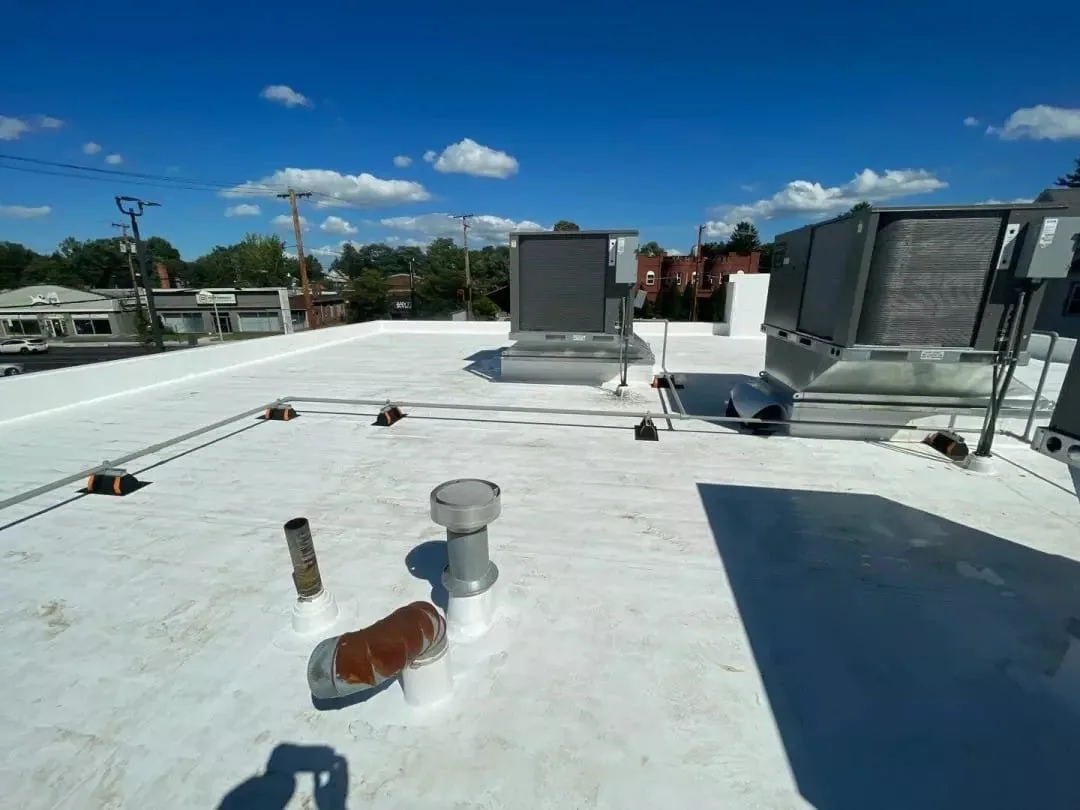
The leak under a rooftop unit is rarely the unit's fault. It is the curb, and the flashing that was supposed to turn that curb into a watertight box. Mechanical trades own the equipment and roofers own the membrane, and the curb sits in the gap where nobody feels responsible. That gap is where we start looking on any building that carries equipment overhead, whether it is an enclosed retail center or one of the office and flex buildings in the Airport Business Center.
Our view is blunt. A curb is a small roof of its own, with corners, an edge and a drainage problem on the uphill side. Build it like a real detail, or plan on chasing it every wet season in Santa Rosa, CA.
Serving Santa Rosa • Rohnert Park • Petaluma • Windsor • Healdsburg • Sebastopol • Napa
Most curb leaks are flashing leaks
Walk a roof with a handful of units and the failures repeat. The base flashing has pulled away from the curb wall because the top edge was only caulked, never fastened under a counterflashing. A corner was folded instead of formed, which leaves a seam in the exact spot where water likes to run.
Then there is the uphill side. On a low-slope roof a curb behaves like a dam. Water heading for a drain hits the upslope face and stops, so a shallow pond sits there after every storm. A cricket, a small sloped saddle that splits the flow around the curb, turns that pond back into a stream. Units installed without one are the units with stained ceiling tile on one side only.
The fix is to rebuild the flashing properly and add the cricket. More sealant is not the fix.
Unit swaps are where roofs get hurt
A replacement unit almost never lands on the old footprint. The new cabinet is a different size, so the mechanical contractor orders an adapter, cuts the old curb, or sets the unit on a curb that no longer matches the opening. Add a crane, a cabinet dragged across the membrane and a handful of loose screws, and the roof takes more damage in one afternoon than in years of weather.
A roofer belongs in that conversation before the order is placed. We ask for a protection plan along the pick path, photographs before and after, and a flashing tie-in once the unit is set and the trades have left. If the membrane is near the end of its life, reroof first or in the same window. Cutting a fresh curb into a roof you will tear off soon is not worth it.
Pipes need supports that move
Heat, ash and rain hit the curbs first
Equipment gathers everything this market throws at a roof into a few square feet. Santa Rosa hit 115 degrees on September 6, 2022, and Healdsburg hit 117; on a day like that, units run flat out beside sealants that soften in the heat. In November 2024 an atmospheric river dropped nearly 15 inches on the city in about three days, and a curb without a cricket, or a drain choked with debris, would have had a lake standing against it.
Fire seasons leave a different mark. Ash from fires like the Tubbs Fire in 2017 and the Kincade Fire in 2019 settles into any gap it can find, including the joint where flashing meets curb. Ash and rain together make a paste that blocks strainers and holds moisture against metal. After any smoke event, clear the curb corners and the drain strainers before the first rain, and look for embers that lodged in louvers and seams.
Build it once, in this order
- Survey the area first: nailers, cant strips, membrane condition and where the water actually flows.
- Build the curb or support with proper cant, a cricket on the upslope side and a counterflashing that sheds water over the base flashing.
- Protect the travel route for the crane and the crew before anything heavy moves.
- Set the unit, then flash and inspect the finished detail in daylight with the mechanical crew gone.
- Record it with photographs so the next leak has a paper trail.
If you own a shopping center, say one like Coddingtown on Mendocino Avenue, that record matters more than it sounds. Tenant buildouts add units over the years, and nobody remembers which one went in when. A roof condition report that maps every curb and support gives the next tenant and the next roofer a starting point.
Skip the sealant tube
Roofing cement over a failed curb is the classic wasted spend. It looks tidy for a season, then cracks in the heat, pulls loose in the damp and hides the real problem. Re-caulking a termination bar is the same mistake in a smaller tube.
Also not worth it: replacing a sound curb because the flashing looks ugly, or coating over a curb on a membrane that is already wet underneath. If the flashing is the problem, we rebuild the flashing. If the curb is rotted, we replace the curb. If neither is true, we tell you to leave it alone and put the money toward drains and scuppers, which protect the roof from the same storms for much less.
Commercial Roofing Questions
Who pays when a new rooftop unit causes a leak, the HVAC contractor or the roofer?
Whoever disturbed the roof is usually responsible for what they disturbed, but proving it takes records. Photograph the area before the crane arrives and again after the flashing work, and insist that the roofer sign off on the curb tie-in before the mechanical crew leaves. Without that paper, you will spend months arguing over whose cut or whose screw it was while water keeps coming in.
Can an existing curb be reused when we swap in a bigger unit?
Sometimes, but check three things before the order goes in: the curb height above the membrane, the condition of the wood inside it, and whether the new cabinet lands on the same opening. If the curb is short or soft, an adapter set on a bad base only moves the problem upward. A rebuilt curb costs less than a ceiling repair in a tenant space, so we lean toward new curbs when the existing ones are old enough to question.
Should we replace the curbs when the whole roof is replaced?
Plan on it for any curb with a rotted nailer, a lost cant or an old sheet-metal skirt, and plan on keeping the ones that pass inspection. Tearing a roof off around a curb you are keeping is workable, and it is cheaper than swapping one that is fine. A full replacement is the cheapest moment to correct curb heights, add crickets and move pipes onto real supports.
Will adding or moving equipment affect the manufacturer warranty on the roof?
Manufacturers write their terms around who may penetrate or alter the membrane and how. Read your warranty before the mechanical bid is signed, and if the roof is under one, have the work flashed by a crew the manufacturer accepts. If the roof is past its warranty, the practical question is who will stand behind the curb flashing. We put our name on the flashing we install and give you the photographs to prove what was done.

Find the leak before the next unit goes in.
Call Commercial Roofing Santa Rosa. We will walk the roof, tell you which curbs and supports need work now, which can wait, and which are fine as they stand.