Flashing Failure Repair in Santa Rosa, CA
Roof Damage Repair
Flashing is the cheapest material on a commercial roof and the first place it lets go. Owners budget for the membrane, argue about the insulation, and treat the strips of metal and membrane at the walls, curbs and pipes as an afterthought. Then the first big rain finds every one of them.
In Santa Rosa, CA the pressure on those strips is unusual. A wet season can drop a month of water on a roof in a few days, a September afternoon can touch 115 degrees, and a building that sits through both moves a little every day. Here is the truth: a roof with sound field membrane and tired flashing is a roof that needs a detail repair, not a new roof, and the repair is cheaper when done before the stain appears.
Serving Santa Rosa • Rohnert Park • Petaluma • Windsor • Healdsburg • Sebastopol • Napa
Where flashing lets go
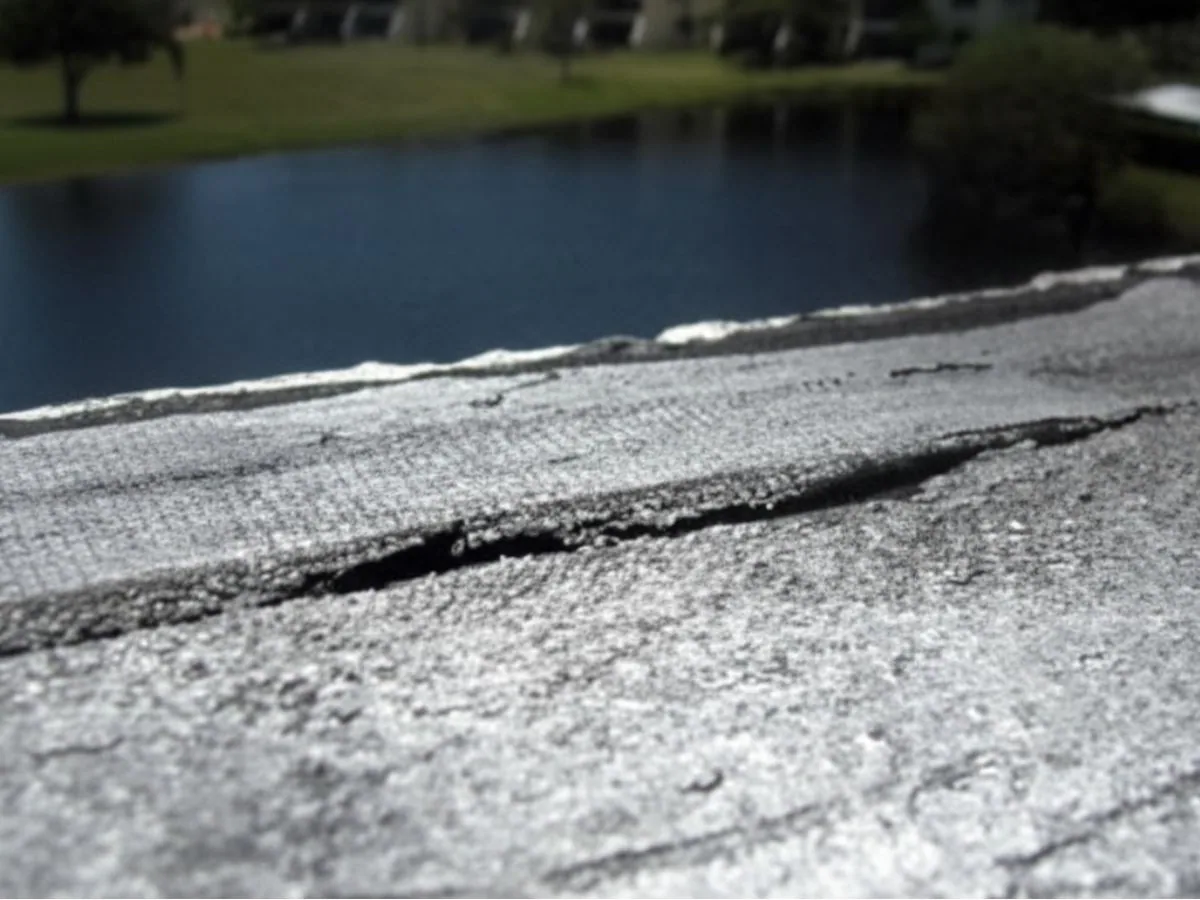
Flashing fails at its ends. The top edge of a wall flashing pulls away from the masonry or the stucco, the corner folds crack, and the lower edge lifts off the roof because the adhesive tired out. A seam where base flashing meets the field sheet opens a hairline, and water does the rest. Sealant lines that were meant to be a backup get treated as the primary defense, and sealant is the first thing that dries and splits.
Penetrations are the other cluster. Pipe boots crack, pitch pockets shrink and drop their fill, and corners cut from stiff material open up as the roof moves. A roof with fifty penetrations has fifty places to leak. Our first pass is a count, because the number of details tells us more about the likely repair than the age of the membrane does.
Old masonry needs careful parapets
The buildings in Railroad Square are a different job from a tilt-up warehouse. The district was listed on the National Register of Historic Places in 1979, and Hotel La Rose at 5th and Wilson, built in 1907 of andesite stone, has walls 20 to 24 inches thick. Rosenberg's Department Store in Railroad Square is listed separately. Masonry of that kind calls for flashing that tucks into a mortar joint or reglet, not a bead of caulk smeared across stone.
That means cutting a clean joint, setting a counterflashing, and fitting it so the wall can breathe and the water still sheds. A working hotel also changes the schedule, because guests sleep under the work and the stone cannot be rushed. Cutting and staging get planned around that, which matters even more on a hotel roof than on a plain commercial one.
Heat moves metal, embers melt plastic
Other trades break the detail
Many flashing failures come from people who were never on the roof to fix it. An HVAC crew swaps a unit and reuses the old curb flashing. A tenant adds a vent or a satellite dish and drills through the sheet. A sign contractor bolts a frame to a parapet. Each leaves a hole sealed with whatever was in the truck.
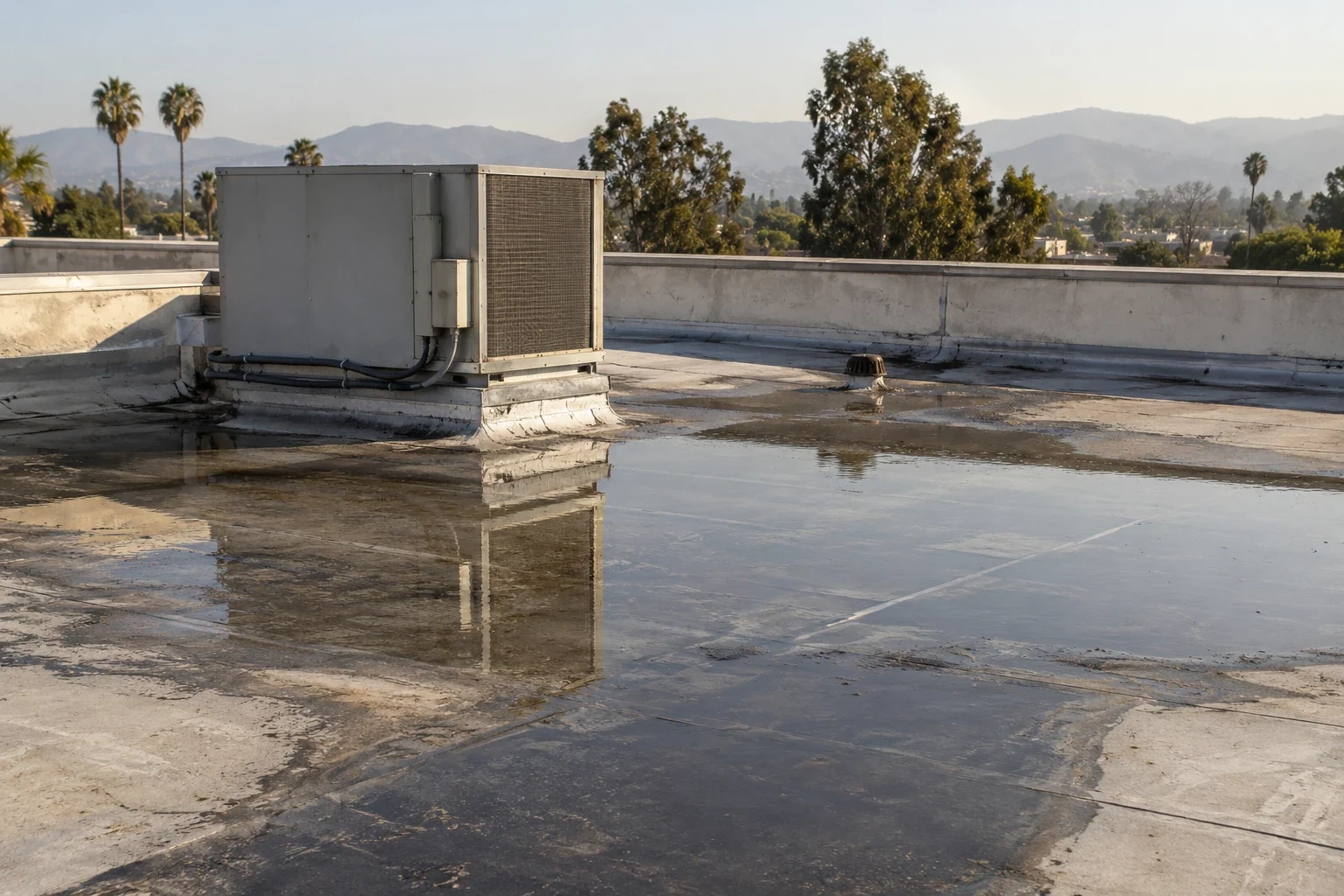
That is common at shopping centers and office parks, where several parties touch one roof. We recommend an access log and a rule: nobody drills, cuts or sets equipment without a roofer there to flash it. When a leak shows up, we trace it back through the rooftop equipment curbs and recent work before blaming the age of the roof.
Rebuild the detail in layers
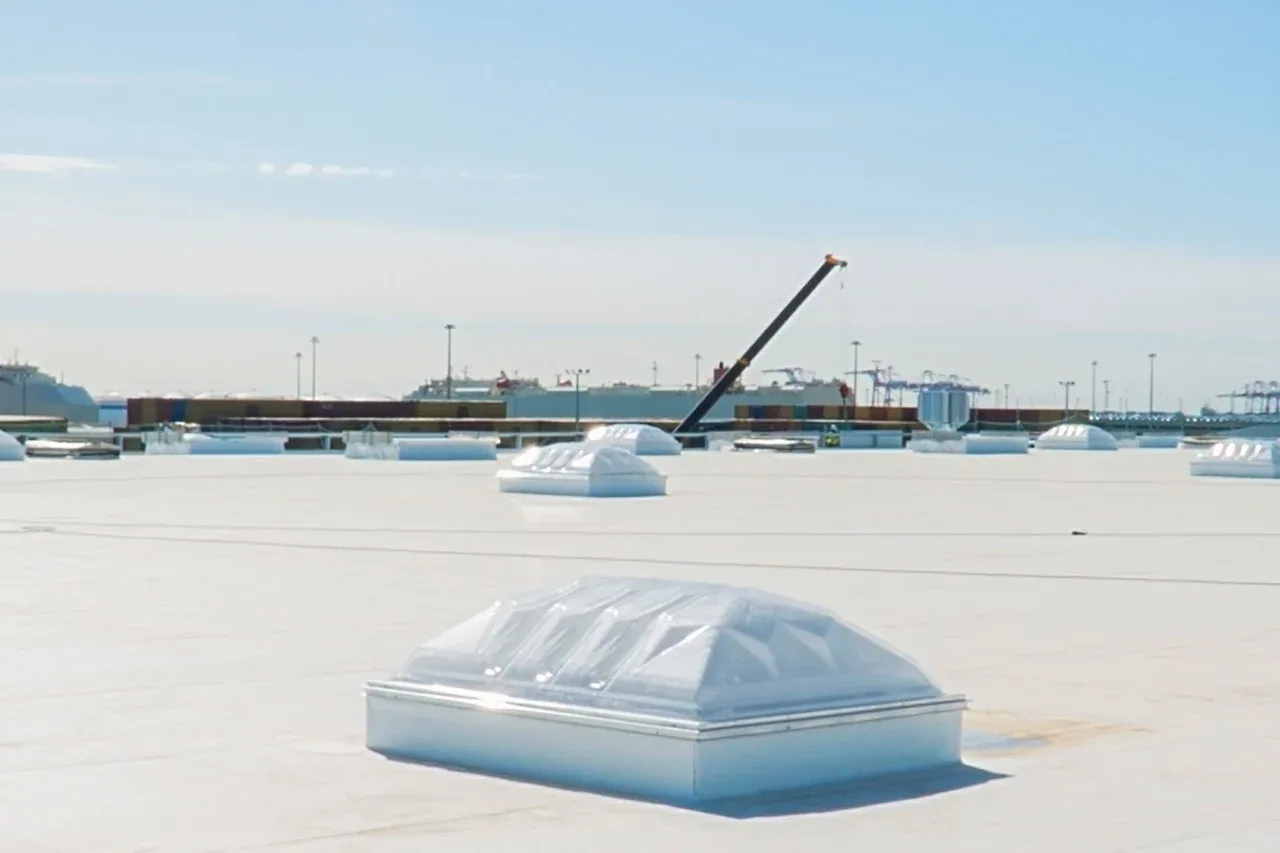
A proper flashing repair removes the failed material back to sound substrate. We clean and prime the surface, install new base flashing that matches the roof system, tie it into the field sheet with a welded or bonded seam, and finish with a termination bar and a counterflashing at the top. Odd shapes and clustered penetrations get a liquid-applied flashing resin, which fills corners that a cut sheet cannot. Skylight curbs and clustered penetration flashing follow the same order every time.
On a modified bitumen roof, the repair uses compatible torch-free or cold-applied materials, depending on what the building and fire conditions allow. The key point is that the new flashing should be made of the same family as the old sheet. Mixing materials leaves a seam that opens in two seasons.
Skip the new roof for a bad detail
Not every leaking roof needs replacing. If the field membrane is dry, well adhered and seamed, a replacement because of bad flashing is wasteful. A leak repair that starts by finding the detail also shows what the rest of the roof looks like, which can be better than the owner assumed.
It is also not worth paying for a coating over open flashing. Coatings bridge hairline cracks but not gaps, and a coated detail with a movement joint under it splits again within a season. Put the money into the termination and the counterflashing, then enroll the roof in preventive maintenance so the details are checked every spring and fall.
Wind may loosen roof edges and flashing together, so inspect the full perimeter before sealing one joint.
Commercial Roofing Questions
Can flashing be repaired without touching the rest of the roof?
Usually, yes. Flashing is a separate layer that ties into the field sheet, so we can remove and replace it in sections while the field stays in place. The condition that changes this is moisture: if water got into the insulation behind the flashing, that area has to be opened, dried or replaced before the new detail goes on.
We keep re-caulking a parapet and it keeps leaking. What is going wrong?
The caulk is being asked to do the job of a counterflashing. Sealant hardens in sun and splits when the wall and roof move at different rates, so each coat lasts a season or less. The lasting repair is a mechanical termination with a metal cap or counterflashing, with sealant used only as a finish. Stop buying tubes and fix the termination.
How do you flash a roof against old stone or brick walls?
We cut a straight joint in the mortar or use an existing reglet, set the counterflashing into it, and seal it so water sheds off the face instead of behind it. Masonry from the early 1900s is often thick and uneven, so each wall gets measured on its own. Sometimes the best option is a surface-mounted termination that avoids cutting historic stone.
How can I tell whether the flashing or the membrane is leaking?
Look where the stain sits relative to the roof edges and equipment. Stains near walls, curbs and pipes point to flashing. Stains in the middle of an open field point to the sheet, a seam or a drain. We confirm by wetting sections in order, isolating one detail at a time, so the repair is based on a test and not a guess.
Is it worth replacing flashing on a roof that is nearly at the end of its life?
Only if the roof will last long enough to repay it. If a replacement is planned within a year or two, a careful temporary repair keeps water out until then. If the roof has several years left, rebuild the detail properly. Either way we tell you where your roof sits relative to that line before work starts.


Show us the leak you keep sealing
Call us about the wall, curb or pipe that keeps coming back. We will look at the detail and tell you plainly whether it needs work now, later, or not at all.