Commercial Roofing in Coffey Park, Santa Rosa, CA
Service Areas
US 101 did not stop the Tubbs Fire, but it did sort what came after. Around 2 a.m. on October 9, 2017, near-hurricane-level winds carried the fire across the highway and into Coffey Park, where an estimated 1,300 structures, mostly detached homes, were leveled. The freeway became the line separating the leveled neighborhoods to the west from the commercial zone to the east.
A commercial roof near a fire like that rarely faces total loss. What it faces is wind work at the edges, ember pitting, ash in the drains, heat-stressed sealant and a documentation job for the insurer. That is the roof work we do for owners near the line in Santa Rosa, CA.
Serving Santa Rosa • Rohnert Park • Petaluma • Windsor • Healdsburg • Sebastopol • Napa
The wind came first
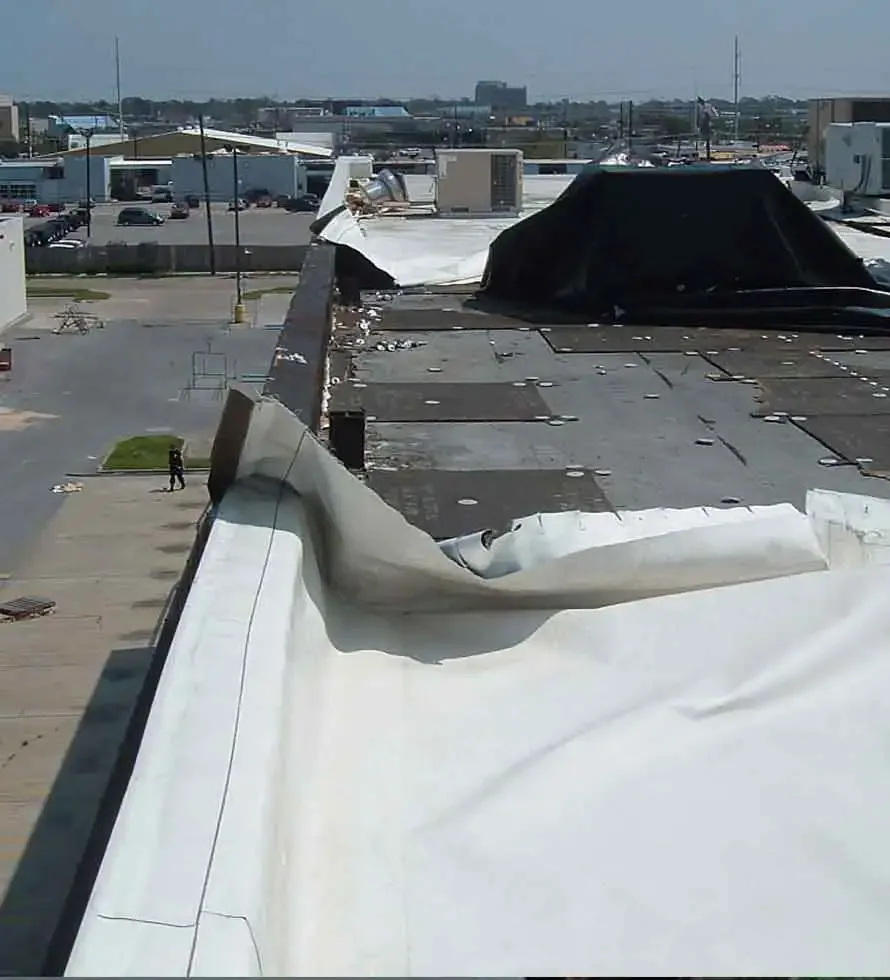
Before a roof ever sees an ember, it takes the wind. During the October 2017 siege Diablo winds gusted up to 70 mph, and the Tubbs Fire ran on winds near hurricane force. Wind attacks a low-slope roof at its perimeter, lifting edge metal and coping, loosening the termination bar on a wall flashing, and finding any fastener that was already backing out.
A roof can lose a little at the edge during a night like that and show nothing inside for months. We start every walk at the perimeter, checking edge metal, coping and gutters for lifted sections, gaps and fresh bends, then work toward the field. Where we find a lifted edge or a billowing membrane, the wind damage repair comes before anything cosmetic, because an open perimeter lets the next storm in.
Three buildings, three burdens
Along US 101, Santa Rosa lost a Kmart, a Hilton hotel and many restaurants. Each of those building types puts a different demand on its roof. A retail box carries rooftop equipment and drains that have to stay clear. A hotel has finished rooms under the roof, so a leak reaches guests. A restaurant adds kitchen exhaust, and grease from it settles on the membrane.
We look at the roof the way the building uses it. For big-box retail roofs the questions are drainage and tenant equipment. At a hotel, the question is how fast a leak can be dried in without disturbing guests. On a restaurant roof, it is grease and the condition of the fan curbs. The right answer changes with the occupant, not the neighborhood.
Document it, then decide
The first winter after a roof is hurt
A roof with small burn pits and cracked sealant can sit dry through a whole summer. The first long rain finds every one of them. Santa Rosa gets about 32 inches a year, mostly November to March, and over three days in late November 2024 an atmospheric river left nearly 15 inches on the city.
The Glass Fire of 2020 left burn scars east of Santa Rosa that raise runoff and debris concerns in heavy rain, which is one more reason to keep drains and scuppers open. Summer adds its own stress: the city hit 115 degrees F on September 6, 2022, and heat expands a damaged membrane the way it expands a healthy one, only with less to spare. A roof damaged by fire deserves a fall visit before every wet season until its condition is settled.
Spend on fire resistance, not appearances
Money goes to waste when it covers damage and does not fix it:
- A fresh coat over ember pits.
- Replacing a sound roof because a neighbor did.
- A repair with no photographs and no date.
- A new membrane on a deck nobody has checked for moisture.
Money that helps is spent on assemblies with a Class A fire rating, which belongs to the whole assembly (membrane, insulation, cover board and deck), not to the membrane alone. Santa Rosa's Wildland-Urban Interface Fire Area map dates to 2009 and is being updated after the Tubbs, Nuns, Glass and Kincade fires, so check where your parcel stands. The same questions come up for owners in Fountaingrove, where the fire also reached.
Railroad Square brings different roof-to-wall details, but fire debris and winter drainage still belong in the inspection record.
For a property in Coffey Park, separate the roof review from any neighborhood-level fire history. Inspect the actual assembly for heat, debris, open seams, damaged flashing, and drainage restrictions; document each observed condition by roof zone. Check rooftop equipment that may have been serviced since the last inspection, because new penetrations can create a separate leak path. The building owner can then prioritize current defects without treating nearby recovery work as evidence about this roof.
Commercial Roofing Questions
The roof looks fine from the parking lot. Is that enough to skip an inspection?
A view from the ground cannot see pitting, softened sealant or a lifted edge. Fire and wind damage on a low-slope roof is often small and low, and it hides behind a parapet. A walk with photographs takes a few hours and answers the question for good. If it finds nothing, you have a dated record that the roof was sound, which is useful if a claim ever comes up.
What should we photograph for an insurer after smoke or wind?
Start with wide shots of each roof section, then close-ups of anything damaged, with a coin or tape measure for scale. Cover the perimeter edge, every curb and penetration, the drains, and the ceiling underneath if there are stains. Date everything, and keep the originals. We assemble the same material in a report, so a claim can reference one organized file.
Does fire risk change which membrane we should choose?
The membrane is only part of the answer, because the fire rating applies to the full assembly. Ask for a Class A rated assembly from the manufacturer, confirm it covers your deck type and insulation, and make sure the edge details and flashing are installed to match. Surface choice then follows the building: reflective single-ply for heat, mod bit or built-up where toughness matters.
How long after a fire can ember damage turn into a leak?
It can take a season or longer. A small pit in the membrane may hold through summer and then open when the roof flexes in cold, wet weather. That is why a fall check after any smoke or ember event is worth the visit. Catching a pit in October means a small repair. Catching it in January means water in the ceiling.
How do wind damage and ember damage show up differently in a report?
Wind damage appears at edges: lifted metal, torn or billowed membrane, displaced flashing. Ember damage shows as scattered burn pits, melted plastic and discolored patches, often where debris had settled. Both are documented separately because they carry different repair scopes and sometimes different claim treatment.

Let us walk the edge
Call and tell us which building near US 101 you manage and what it came through. After we have walked it, you will hear plainly whether the roof needs work now, later, or not at all.