Commercial Roofing in Larkfield-Wikiup, CA
Service Areas
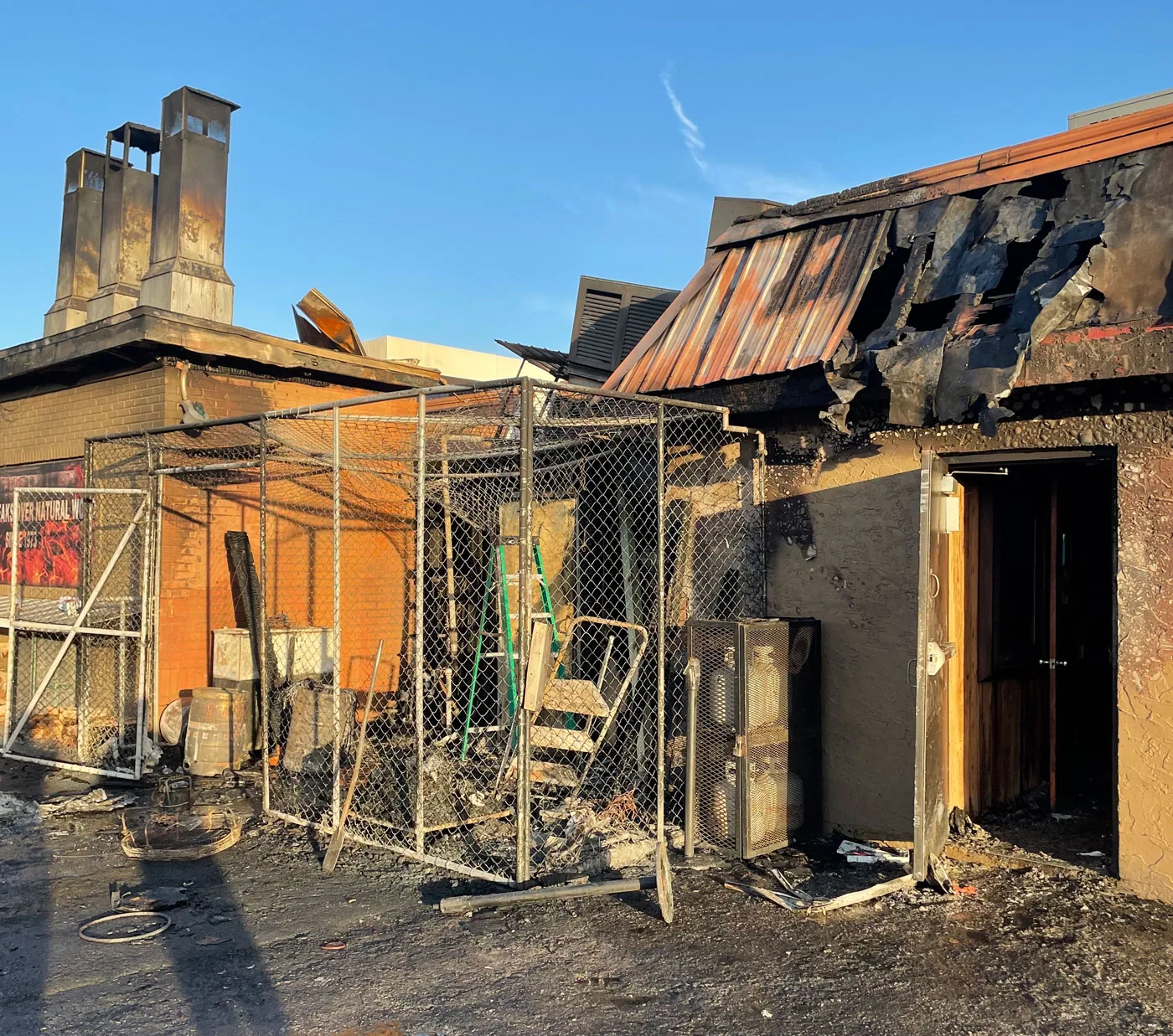
Flames are rarely what ruin a commercial roof near a wildfire. Embers do the damage, and ash and smoke do the cleanup. Larkfield-Wikiup has seen the pattern: the 2017 Tubbs Fire destroyed approximately 500 homes in the area, and the 2019 Kincade Fire reached the community's borders in extreme winds and forced evacuations.
About 5 miles north of Santa Rosa, CA, the community has 8,492 residents and housing developments interspersed with vineyards, farms and light industry. We repair, recover, coat and replace commercial roofs in Larkfield-Wikiup, CA, and the work starts with a question that has nothing to do with membrane brands: what is sitting on, behind and under the roof that could catch or hold an ember?
Serving Santa Rosa • Rohnert Park • Petaluma • Windsor • Healdsburg • Sebastopol • Napa
Light industry among the vines
A community that mixes houses, vineyards, farms and light industry has an odd roof inventory. The buildings can run from a modest industrial unit under a flat membrane to a metal-clad production or storage building to a farm structure that was never designed with a roof maintenance schedule in mind. We do not assume which one you have. We find out on the roof.
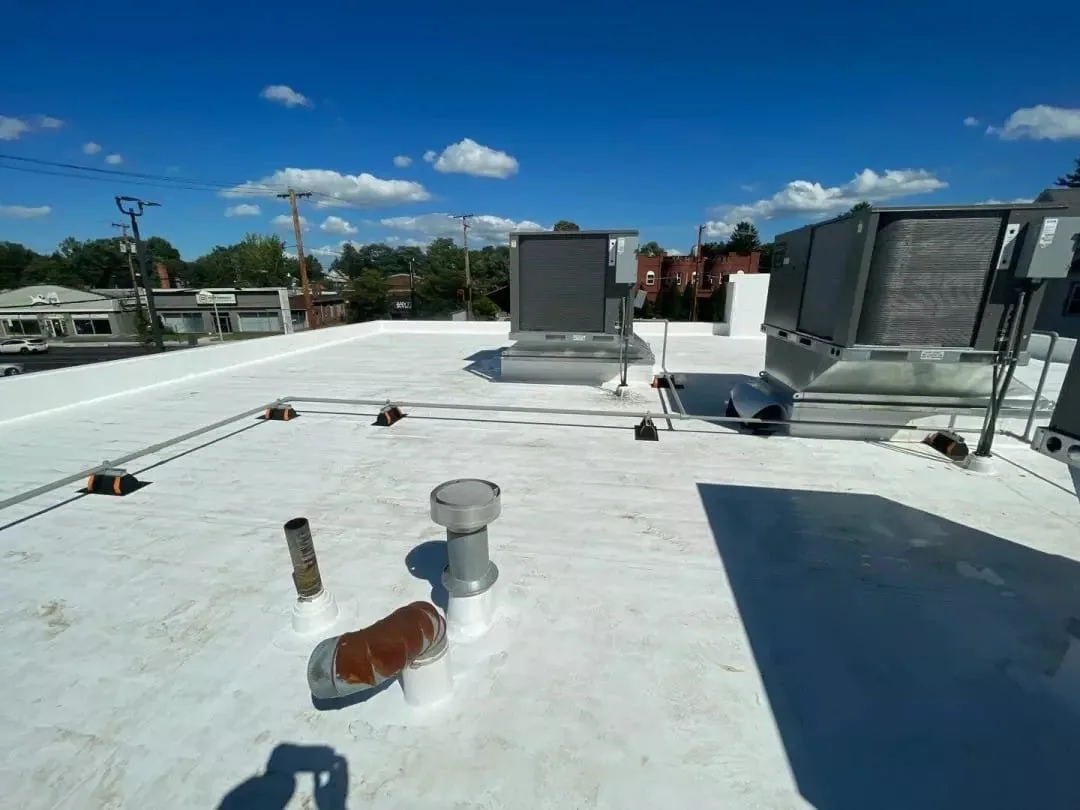
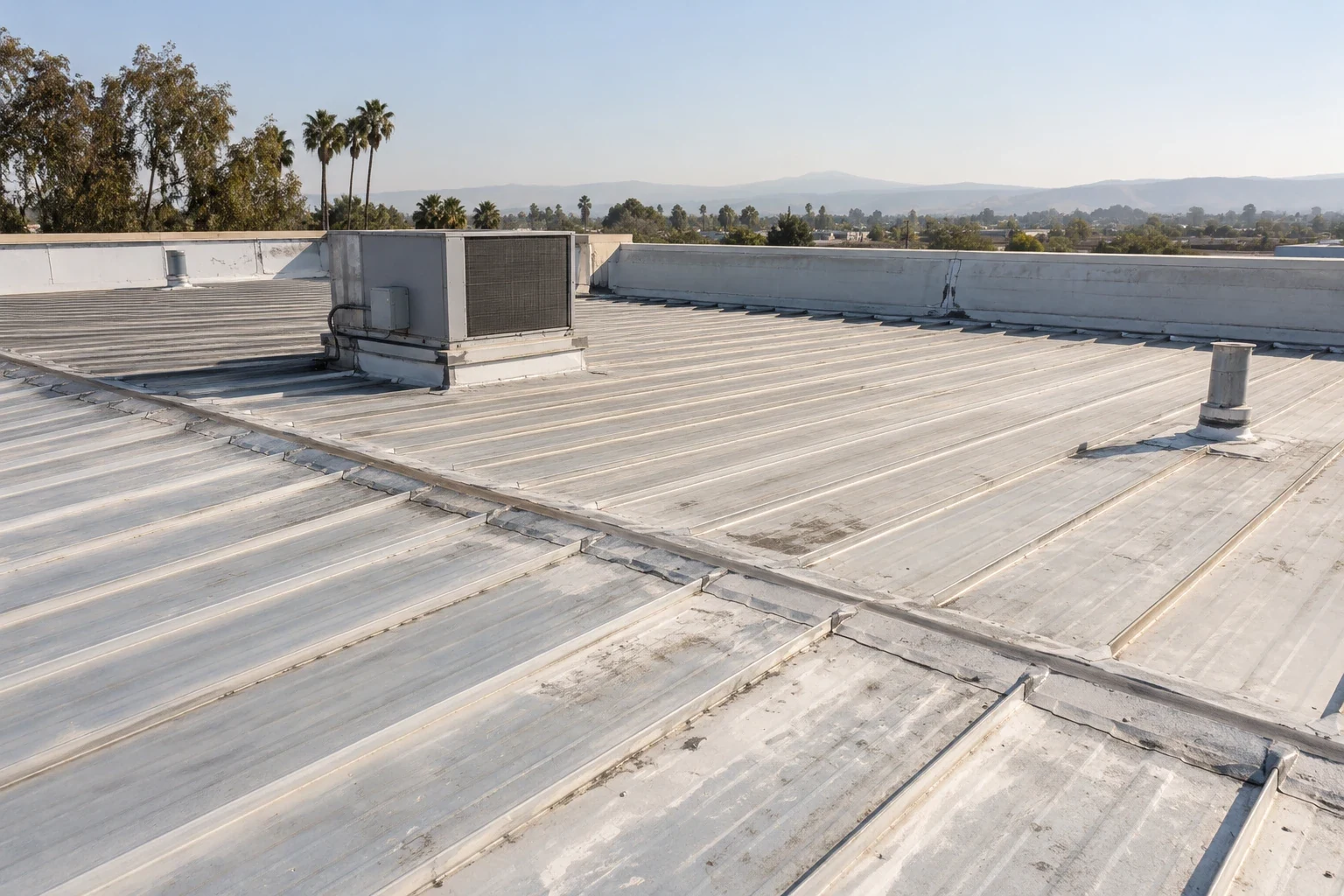
What we look for is the same across all of them: how old the roof covering is, whether the fasteners and seams are holding, whether insulation under a metal panel has been wet, and whether the rooftop has accumulated needles, leaves and dust. A flat industrial unit brings the drain, curb and rooftop-unit questions that come with flex and light industrial roofing. For an older metal building, the answer is often a metal roof retrofit that goes over the existing panels and avoids a full tear-off.
Know what you have before you decide what to spend.
Where embers get in
Embers do not need an open flame to start something. They need a place to land and something dry to land on. On a commercial roof, that place is a drift of debris against a parapet, a gap at an edge, an open vent, or the corner where a curb meets the membrane. Clean those spots and half the exposure goes away.
On a first walk we clear and photograph the debris line, check screens on vents, look at the gaps under flashing and edge metal, and note any combustible material stored on or against the roof. The Sonoma County reroofing guidelines, put together by the county, the cities' building departments and the North Bay independent roofing contractors, note that the Chapter 7A wildfire-exposure rules apply to new construction and not to reroofing. That means a reroof does not trigger those rules on its own. Doing the work anyway pays off. When we are already on the roof, making the vents, edges and penetrations harder for an ember to enter costs far less than doing it later. Fire damage repair after a loss costs a great deal more.
Empty building, silent leak
Wind and heat finish the job
Diablo gusts of up to 70 mph ran through the October 2017 fire siege, which cost the North Bay 5,643 structures to the Tubbs Fire and another 1,355 to the Nuns Fire. Wind like that finds any roof edge that is loose. Metal edges and the first few feet of membrane at a corner get the highest uplift, so they are the first thing we check on a roof that has been through a fire year. Any wind damage repair starts at those same edges.
Heat puts a second stress on top. Santa Rosa reached 115 degrees on September 6, 2022, and Healdsburg hit 117 that day. A roof that has already cracked sealants or lost some granules will age faster in heat like that. For a building with a sound deck and a membrane with life left in it, a reflective coating can slow the aging. For one with wet insulation, it just seals the water in.
Skip these
Some roof spending near fire country does nothing:
- Roof coatings advertised as fireproof. No coating makes a roof immune to embers, and a coating over wet insulation makes things worse.
- Replacing a roof that came through the fire intact, when a cleaning and a repair would do.
- Ignoring drains until the first big storm has already packed them with ash.
- Patching a vent screen with tape.
Not every roof here needs replacing. Many need a thorough cleaning, new vent screens and sealed edges, and then a calendar reminder to do it again before the next fire season.
Commercial Roofing Questions
Our building came through the Tubbs Fire untouched. Does the roof still need a check?
Check it anyway, because heat, smoke and ash do damage that cannot be seen from the ground. Radiant heat can soften sealants and distort flashing without scorching the surface. Ash left in low areas can degrade the membrane over time. A walk with photos confirms whether the roof is sound or just looks that way, and it gives you a baseline for later.
Should we upgrade vents and edges during a reroof even if the code does not require it?
Usually yes, for the openings. Vents, gutters, edge metal and the junction between wall and roof are where embers enter, and improving them while the roof is open adds little to the cost. Upgrading the entire roof assembly is a bigger decision and depends on the building. We list the options with the added cost for each so you can choose.
What is the right way to clean ash off a commercial roof?
Remove it dry. Use soft brooms or a vacuum to pick it up, bag it, and keep it out of the drains. Rinsing first sends alkaline slurry into the drain lines, and the film it leaves can attack some membranes. After the dry removal, a light rinse is fine. Clear scuppers and drains afterward so the next rain has a path.
We were evacuated for days. What should we look for when we get back?
Start inside, with the ceiling tiles, the corners and the area under any rooftop unit. Stains or sagging tiles tell you where water entered. Then go up to the roof and trace backward from the stain. Look for loosened flashing, lifted seams and blocked drains. Photograph what you find before any cleanup begins.
Is a metal-clad farm or production building worth reroofing, or does a coating do the job?
Coat it if the panels are sound, the fasteners are tight and the insulation underneath is dry. A coating buys years on a roof like that for much less money than panels. It is not worth it on a roof with rusted-through panels, backed-out screws or damp insulation. Those need a retrofit or replacement, and we say so after looking.
Tell us what you own
Call and tell us what is on the property in Larkfield-Wikiup. After we have walked the roof, we will say plainly whether it needs work now, later, or not at all.