Commercial Roofing in Forestville, CA
Service Areas
Front Street in Forestville is a three-block downtown, and it is easy to treat its roofs as three blocks of the same problem. They are not. A grocery store, a pharmacy, a hardware store and restaurants load a roof in different ways, and a plan that fits one can be flat wrong for the next.
Forestville has 3,264 residents along State Route 116, a road that carries the names Pocket Canyon Highway, Front Street and Gravenstein Highway through town. We repair, recover, coat, inspect and replace commercial roofs in Forestville, CA, and we begin with what is under each roof, not how the building looks from the street. The right answer can be that one section needs real work and the rest needs a tune-up.
Serving Santa Rosa • Rohnert Park • Petaluma • Windsor • Healdsburg • Sebastopol • Napa
Four tenants, four loads
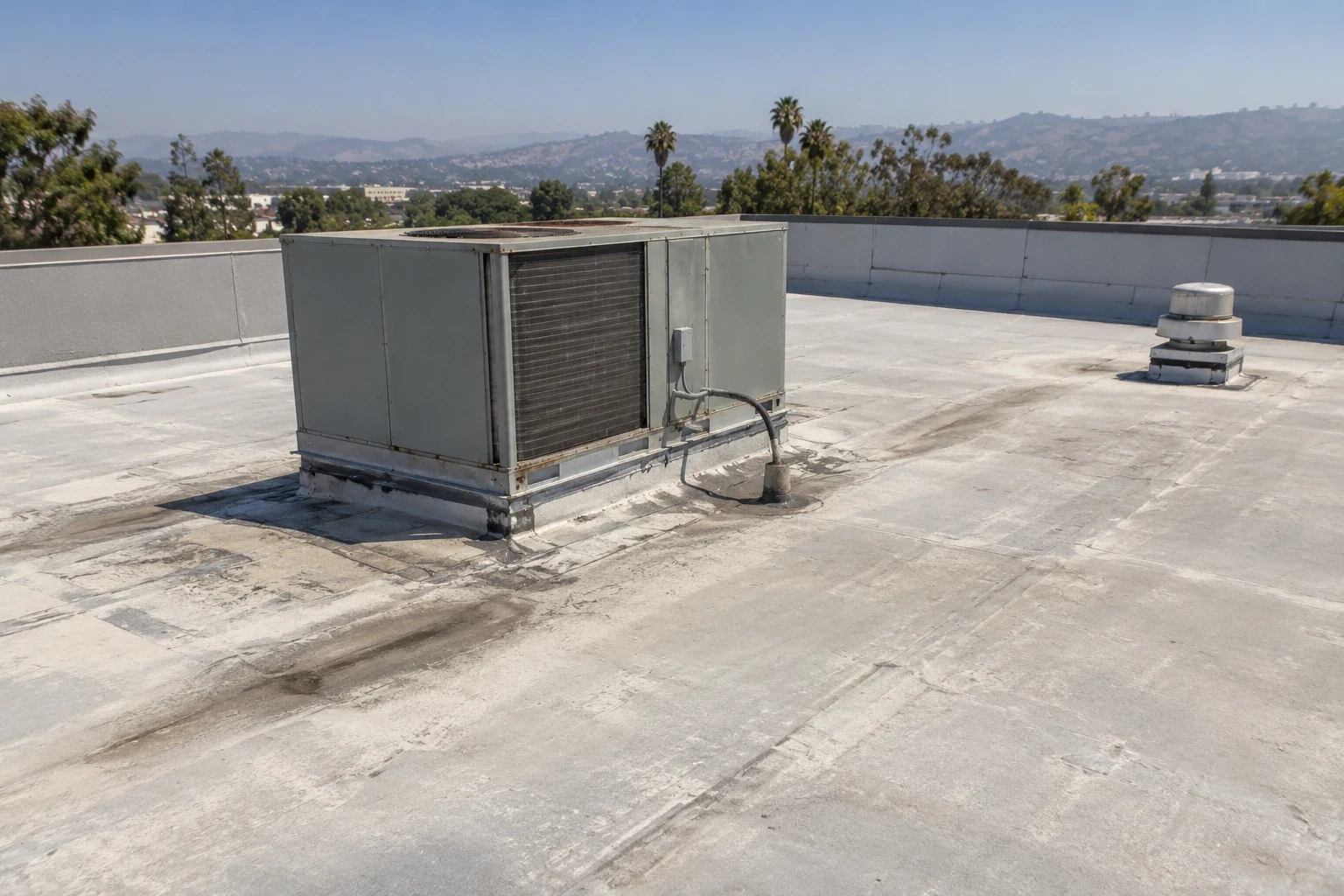
A grocery store is usually the hardest-working roof on a block. Refrigeration condensers, exhaust fans and vent lines put weight, heat and penetrations on the membrane, and each one sits on a curb that can settle or lose its flashing. A pharmacy leans on air handlers that cycle all day. A restaurant adds kitchen exhaust and the grease that comes with it. Which of those rooftops holds which equipment is something the first walk answers, not the storefront sign.
That is why one roofing plan rarely fits a whole row. A grocery store roof wants its equipment mapped and its drainage protected. A building with kitchen exhaust wants a hard look at the curbs and equipment supports and a protected walking path. Here is the truth about mixed rows: the roof ages at the speed of its busiest tenant, not its quietest.
Three blocks leave no staging room
A three-block downtown has almost no spare ground. Material, a lift and a dumpster have to sit somewhere, whether that turns out to be a rear lot, a loading area or a lane of Front Street itself. We walk the site before pricing, pick the staging spot, and plan the work so deliveries land early and the roof is dried in before the afternoon crowd arrives.
State Route 116 is the road everyone shares, so truck movements get timed around it, not argued with it. Customers keep walking in and out of a grocery store or a pharmacy during a reroof, and that means a protected entrance, clear signs and a spotter on the ground when something is lifted. Reroofing an occupied building is mostly a logistics job with a roof at the end of it.
Inns and wineries toward the river
Rain, heat and smoky air
In Santa Rosa, CA, a typical year brings about 32 inches of rain, nearly all of it from November through March. The atmospheric river that arrived November 21 to 23, 2024 left almost 15 inches in roughly three days. Healdsburg, at the north end of the service area, runs wetter and hotter than coastal Sonoma County, averaging about 42 inches a year with July highs near 89 degrees F.
Heat arrives in bursts. Santa Rosa hit 115 degrees F on September 6, 2022, and Healdsburg reached 117. The Kincade Fire of 2019 burned 77,758 acres near Geyserville, and ash and smoke from fires like it settle on roofs far from the flames. Ash clogs drains and holds water against seams, so after any smoke event we recommend a roof inspection that includes the gutters and scuppers, the ordinary place where the next storm begins its damage.
Coat, patch or replace
Dry insulation and a sound membrane point to a restoration coating, and that choice keeps tenants working through the job. Wet patches mean cutting out the damaged sections and repairing around them. A roof that is wet across the field or too brittle to hold a coating needs replacement, and a permit application submitted on or after January 1, 2026 comes under California's 2025 Building Standards Code and Energy Code. Confirm the insulation and roof-surface requirements with the building department before the price is final.
Cost follows the tear-off, the insulation, the equipment count and how hard the roof is to reach. Timing follows tenants, weather and material lead time. A priority-one fix such as a failing drain or a pulled flashing should not wait for the full project, and we say so plainly when it is the only thing that cannot wait.
What is not worth it
Some spending in a small downtown looks responsible and is not:
- A coating sprayed over wet insulation, which locks the water in.
- Replacing a whole roof to cure a leak that started at a single curb.
- Patching each tenant's leak separately without checking the drain they share.
- Picking a membrane because the building next door has it, instead of for the equipment on your own roof.
Find the cause, fix it once, and keep a record of it. Owners in Guerneville and Sebastopol, the other towns on State Route 116, get the same advice.
Commercial Roofing Questions
Should a grocery store and the shops beside it share a single roof contract?
Keep the contract single but the scopes separate. One contractor and one calendar avoids finger pointing when a leak crosses a wall, yet each roof section needs its own condition rating and its own plan. The grocery's equipment-heavy roof will often want work before the quiet ones. Price them as separate lines so you can fund the worst first.
What is the best time of year to reroof a winery building?
Early spring through early summer, before harvest takes over the yard and while the weather is dependable. Plan the scope during the wet months, order material early and book the crew for the window between the last storm and the first crush. A roof job that collides with harvest forces compromises on access, and compromises on a roof usually leak later.
How do we keep guests comfortable during a roof job at an inn?
Settle the schedule with the person who runs the front desk, not the person who writes the check. Noisy tear-off goes to the hours when the fewest guests are in rooms, and materials move through service routes, not the main entrance. Rooms directly under active work are best left empty for a day or two, and that is cheaper than complaints.
Can a grocery store roof stay in service during a replacement?
It can, with staging. The roof comes off in sections, each one dried in before the next opens, and the refrigeration equipment is protected and reconnected without interrupting the store's cooling. Roof access is planned around deliveries and the busiest customer hours. A store that cannot tolerate any interruption is a candidate for recover work instead of tear-off.
How can I tell whether a stain is old or active?
Look at the edges and the weather. Old stains have dry, hard borders, and active ones darken or grow after rain. Mark the outline in pencil with the date, then check it again after the next storm. If it grows, trace the water to the roof, because the source is often several feet from the stain. Test the insulation before deciding on any repair.
Start with a walk
Call and tell us the building and what the roof has been doing. After we walk it, you will hear plainly whether it needs work now, later, or not at all.